Last Updated on May 12, 2026 by admin
Ask someone on the street what the United Kingdom is, and they’ll probably say “England” without missing a beat. It’s an understandable mistake — England is the largest, the loudest, and the one that tends to dominate the international imagination. But the United Kingdom is not England. It never has been. The full picture is richer, more complicated, and frankly more interesting than that.
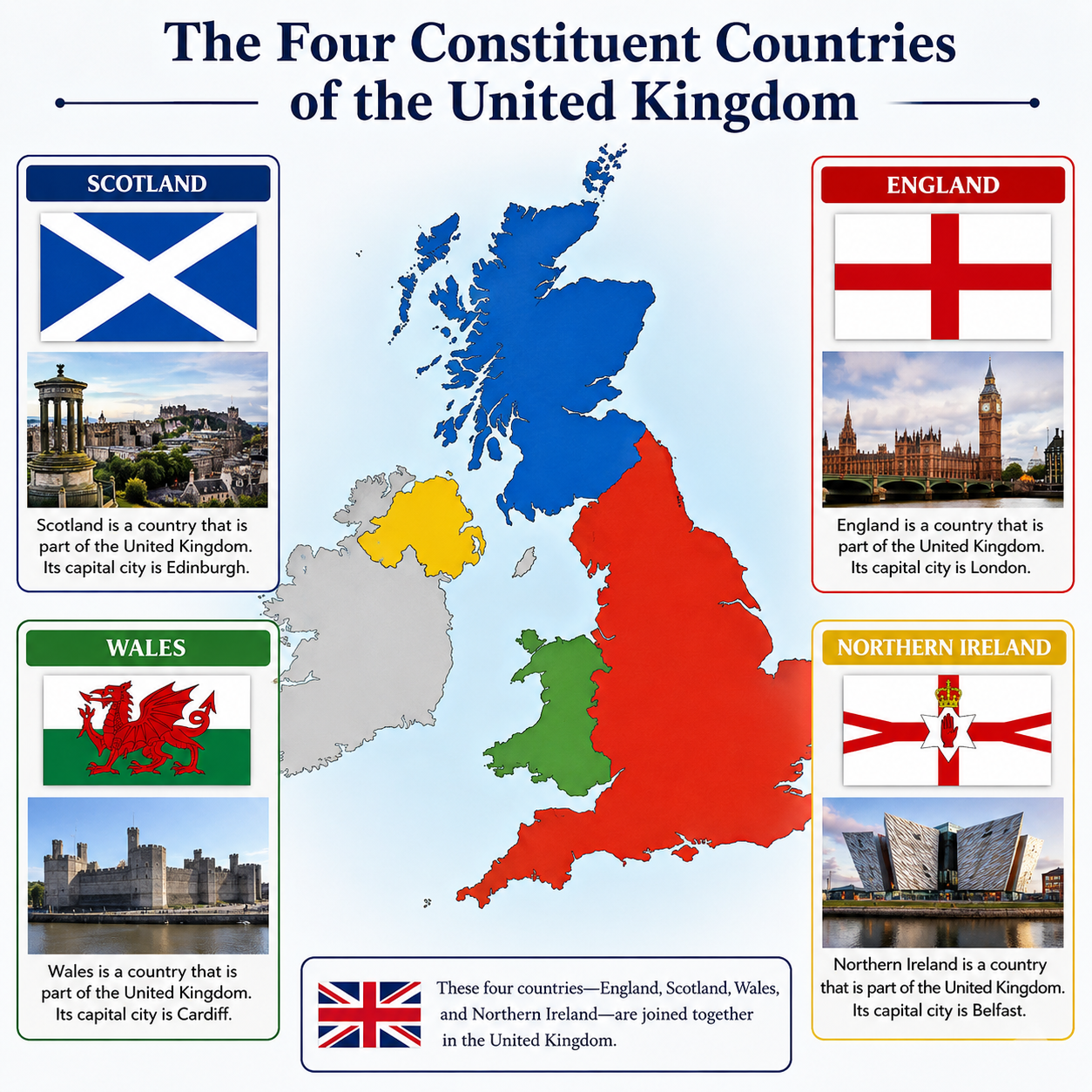
The United Kingdom of Great Britain and Northern Ireland — its official, full name — is made up of four distinct constituent countries: England, Scotland, Wales, and Northern Ireland. Each has its own history, its own culture, its own identity, and in many cases, its own government. They share a monarch, a parliament (for most major decisions), and a passport, but ask someone from Cardiff if they’re English, or someone from Edinburgh, and you’ll quickly understand just how different these four nations truly feel.
Let’s take a proper look at each one.
Read: What’s the Difference between Credit Score vs Credit Rating
England
England is the country that most outsiders picture when they think of the United Kingdom. It is, without question, the dominant force within the union — home to roughly 56 million of the UK’s approximately 67 million people, and containing the capital city, London, which is not just the seat of UK government but one of the most influential cities on the planet.
England’s history is one of the most documented in the world. The Romans came and built roads. The Anglo-Saxons settled and shaped the language. The Normans invaded in 1066 and rewired the social and political order. From there, England expanded — sometimes peacefully, often not — and became the engine of what would eventually become the British Empire, one of the largest empires in human history.
But England is far more than its imperial past. It is the country of Shakespeare, Dickens, the Beatles, the Rolling Stones, and the Premier League. It gave the world the English language — now spoken by over a billion people globally — and contributed enormously to science, literature, philosophy, and law.
Geographically, England is divided into regions with strikingly different characters. The north — cities like Manchester, Liverpool, Leeds, and Newcastle — has a working-class industrial heritage, a fierce pride, and a warmth that often surprises visitors expecting the stiff formality they associate with the south. The Midlands are the industrial heartland, where the engines of the Industrial Revolution roared to life. And then there’s London — a world unto itself, a city that is arguably more global than it is English, where more than 300 languages are spoken and no single culture dominates.
England does not have its own devolved parliament the way Scotland and Wales do — a quirk that some English politicians and citizens have long found frustrating. English matters are handled directly by the UK Parliament at Westminster, where all four nations are represented but England carries the most weight by sheer population size.
🇬🇧 Cities in England (United Kingdom)
London Region
- London (capital city)
South East England
- Brighton and Hove
- Canterbury
- Oxford
- Portsmouth
- Southampton
- Winchester
- Chichester
- Ely
- St Albans
- Rochester (historical city status)
South West England
- Bristol
- Bath
- Exeter
- Gloucester
- Plymouth
- Truro
- Salisbury
- Wells
- Hereford (border region but often grouped here)
East of England
- Cambridge
- Norwich
- Peterborough
- Chelmsford
- Southend-on-Sea
- Luton
West Midlands
- Birmingham
- Coventry
- Stoke-on-Trent
- Wolverhampton
- Worcester
- Lichfield
East Midlands
- Nottingham
- Leicester
- Derby
- Lincoln
North West England
- Manchester
- Liverpool
- Chester
- Lancaster
- Carlisle (border but often grouped North West)
North East England
- Newcastle upon Tyne
- Sunderland
- Durham
- York
Yorkshire and the Humber
- Leeds
- Sheffield
- Bradford
- York (also listed above due to historical overlap)
- Kingston upon Hull
Read: Definition of Credit Unions and How They Compare to Banks
Scotland
If England is the loud older sibling, Scotland is the one who never lets you forget they have their own story to tell — and it’s a very good one.
Scotland occupies the northern third of the island of Great Britain. It has around 5.5 million people, vast stretches of dramatic highland wilderness, more than 790 islands, and a cultural identity so distinct that the question of independence has never really left the national conversation. The 2014 independence referendum saw 55% vote to remain in the UK, but the debate is ongoing — and shows no signs of quietly going away.
Scotland’s relationship with England has been long, complicated, and sometimes bloody. The two kingdoms fought repeatedly over centuries, producing figures like William Wallace and Robert the Bruce, whose stories have been immortalised in everything from medieval chronicles to Hollywood films. The Act of Union in 1707 formally merged the Scottish and English parliaments, but Scotland retained its own distinct legal system, its own education system, and its own Church — the Church of Scotland, which is Presbyterian, not Anglican like the Church of England.
In 1999, Scotland gained its own devolved parliament in Edinburgh — Holyrood — with significant powers over areas like health, education, justice, and taxation. The Scottish National Party (SNP) has governed there for the better part of two decades, and independence remains their central ambition.
Culturally, Scotland punches well above its weight. It gave the world the telephone (Alexander Graham Bell), penicillin (Alexander Fleming), the television (John Logie Baird), and an extraordinary literary tradition stretching from Robert Burns to Irvine Welsh. Scots is a distinct language spoken by hundreds of thousands, and Scottish Gaelic, though spoken by fewer than 60,000 people, is actively being preserved and promoted.
Then there’s the landscape — genuinely one of the most dramatic in Europe. The Cairngorms, Loch Ness, the Isle of Skye, Glencoe: these are not just tourist backdrops. They are places that feel ancient and alive in a way that’s hard to put into words. Scotland is also the home of whisky (spelt without the ‘e’, and yes, that distinction matters to a Scot), golf, and the Highland Games. It is a country that wears its traditions with genuine pride rather than nostalgia
.
🇬🇧 All Cities in Scotland
Central Belt (Most populated cities)
- Glasgow – Scotland’s largest city, known for industry, culture, and music
- Edinburgh – Capital city, famous for history, festivals, and government institutions
Eastern Scotland
- Dundee – Known for technology, design, and universities
- Aberdeen – Major energy and oil industry hub
- Dunfermline – Historic royal city, recently granted city status (2022)
Northern Scotland
- Inverness – Often called the “capital of the Highlands”
Central & Southern Scotland
- Perth – Known as the “Gateway to the Highlands”
- Stirling – Historic city famous for its castle and battles
Read: What is Mortgages: Types, Interest Rates, and How to Repay”
Wales
Wales is often the least understood of the four nations — even by people in the UK itself. Wedged into the western peninsula of Great Britain, with a population of around 3.2 million, Wales is the smallest of the three countries on the main island. But in terms of cultural depth and linguistic identity, it stands apart from all the others.
The Welsh language — Cymraeg — is not a novelty or a historical curiosity. It is a living, breathing language spoken daily by around 880,000 people, roughly 29% of the Welsh population. Road signs across Wales are bilingual. Government documents are produced in both English and Welsh. Children are taught it in school. It is one of the oldest languages in Europe, part of the Celtic family, and its survival against centuries of English political and cultural pressure is nothing short of remarkable.
Wales was formally annexed by England under the Laws in Wales Acts of 1535 and 1542, making it the first of the four nations to be politically absorbed by England. For centuries, Welsh culture and language were actively suppressed — there were periods when speaking Welsh in schools was punishable by humiliation and punishment. That history has left a mark. Welsh identity is not just cultural pride; it carries the weight of survival.
In 1999, Wales gained its own devolved institution — the Senedd (Welsh Parliament) — initially with more limited powers than the Scottish Parliament, but its authority has expanded over time. Today, the Senedd has powers over areas including health, education, local government, and some taxation matters.
Wales is a land of valleys and mountains, coal and rugby, male voice choirs and Dylan Thomas. The south — with Cardiff, Swansea, and the former coal-mining valleys — is more densely populated and urbanised. The north and mid-Wales are wilder, more rural, and more strongly Welsh-speaking. Cardiff became the official capital only in 1955 (remarkably recently), and it has grown into a vibrant, modern city with a strong sense of its own identity.
Welsh rugby is not a sport; it’s a religion. On match days, particularly against England, the atmosphere inside the Principality Stadium in Cardiff is something that has to be experienced to be believed — 74,500 people, many draped in red, singing Hen Wlad Fy Nhadau (Land of My Fathers) with a fervour that sends chills down the spine of anyone lucky enough to witness it.
Read: What is Fiscal Policy: Objectives and Types
Major Welsh Cities
- Cardiff – Capital city of Wales and largest urban area, known for its waterfront and government institutions
- Swansea – Coastal city famous for its bay, maritime history, and universities
- Newport – Important commercial and transport hub in South Wales
Historic & Cultural Cities
- Bangor – One of the oldest cities in Wales, known for its cathedral and university
- St Davids – The smallest city in the UK, famous for its cathedral and religious heritage
- St Asaph – One of the smallest cities in Britain, known for its historic cathedral
Newest Welsh City
- Wrexham – Became a city in 2022 during the Queen’s Platinum Jubilee celebrations
Northern Ireland
Northern Ireland is the most geographically and politically complex of the four nations. Situated on the northeastern corner of the island of Ireland — physically separated from the rest of the UK by the Irish Sea — it has a population of around 1.9 million and a history that cannot be understood without acknowledging the profound divisions that have shaped it.
Northern Ireland exists because of partition. When Ireland gained independence from British rule in 1922, six counties in the northeast — with a majority Protestant and unionist population — remained part of the United Kingdom. That decision was the beginning of a deep and lasting tension. On one side: unionists and loyalists, predominantly Protestant, who want Northern Ireland to remain part of the UK. On the other: nationalists and republicans, predominantly Catholic, who want a united Ireland.
From the late 1960s to 1998, Northern Ireland endured a period known as The Troubles — a brutal conflict between paramilitary groups, security forces, and civilians that claimed more than 3,500 lives. The Good Friday Agreement of 1998 is one of the great political achievements of the late 20th century. It brought a formal end to the violence, established a power-sharing assembly at Stormont in Belfast, and created new cross-border bodies linking Northern Ireland with the Republic of Ireland to the south.
The peace has held — though it remains fragile. Brexit complicated things enormously. Because Northern Ireland shares its only land border with the Republic of Ireland (an EU member), leaving the EU required careful negotiation to avoid reintroducing a hard border that many feared could destabilise the peace process. The result — the Northern Ireland Protocol, later revised as the Windsor Framework — created a unique trading arrangement that has satisfied almost no one entirely, but has at least kept the peace.
Northern Ireland has its own devolved Assembly at Stormont, though it has been suspended multiple times due to political disputes between unionist and nationalist parties. Power-sharing requires both sides to govern together, and when trust breaks down, the institutions collapse. It’s a fragile architecture, but it’s also a genuine attempt to hold two very different visions of identity within a single governing framework.
Beyond the politics, Northern Ireland is a place of extraordinary beauty and character. The Causeway Coast, with the famous Giant’s Causeway — a UNESCO World Heritage Site of hexagonal basalt columns — is stunning. The Mourne Mountains, Belfast’s regenerated waterfront, the walled city of Derry/Londonderry (even its name reflects the political divide) — all of it tells a story of a place that is deeply layered and refuses to be reduced to its conflict alone.
Belfast, the capital, has undergone a remarkable transformation. Once synonymous with sectarian violence and industrial decline, it is now a thriving city with a world-class food scene, a booming creative industry, and an increasing number of visitors who come to understand its complex past through excellent museums like the Titanic Belfast — a fitting tribute, given that the famous ship was built right there, in the Harland and Wolff shipyard, in the early 20th century.
Cities in Northern Ireland
Major Cities
- Belfast – Capital and largest city, known for its shipbuilding history (RMS Titanic) and political significance
- Derry (also called Londonderry) – Historic walled city, important cultural and political centre
Other Official Cities
- Lisburn – Modern city known for linen production and proximity to Belfast
- Newry – Key commercial and transport city near the border with the Republic of Ireland
- Armagh – Historic ecclesiastical capital of Ireland, known for its cathedrals

Contact: Kokobest04@gmail.com
- Loan Refinancing vs. Debt Consolidation: What Is the Difference? - October 7, 2026
- How business revenue and credit scores affect loan size - October 3, 2026
- Business Line of Credit vs. Term Loan: Understanding the Difference - October 3, 2026