Last Updated on May 16, 2026 by admin
With hundreds of millions of active users, X (formerly Twitter) remains one of the most powerful, fast-paced, and direct-to-consumer digital channels on the planet. For businesses, it is no longer just a megaphone for PR announcements; it is a real-time marketplace, a customer service hub, and a high-velocity engine for generating inbound sales.
X gives businesses direct access to consumers, industry conversations, and viral potential that few other platforms can match. But success on X is not accidental — it requires strategy, consistency, and a deep understanding of how the platform works.
Here is a comprehensive guide to using X effectively to market your business and increase sales.
Read: The Four Constituent Countries of the United Kingdom
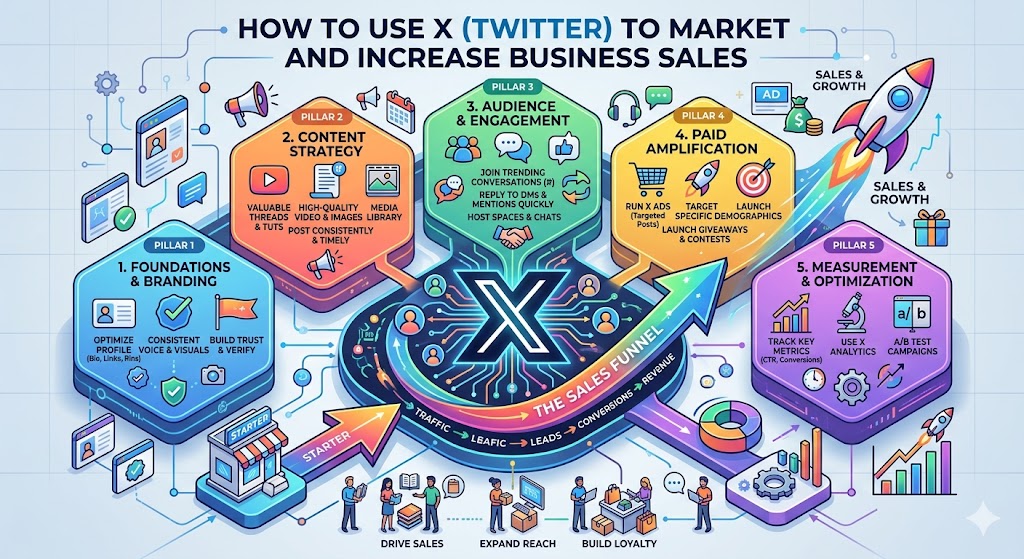
1. Optimise Your Profile for First Impressions
Your X profile is your digital storefront. Before you post a single tweet, make sure every element of your profile communicates professionalism and purpose.
Username: Use your business name or a close variation. Keep it short, memorable, and consistent with your branding across other platforms.
Profile photo: Use your company logo. This builds brand recognition every time you post or engage.
Header image: This is prime real estate. Use it to showcase a product, a current promotion, a tagline, or your team. Update it seasonally or around campaigns.
Bio: You have 160 characters. Use them wisely. State clearly what your business does, who you serve, and include a value proposition or a touch of personality. Add relevant keywords so you appear in search results, and always include a link to your website or a specific landing page.
Pinned post: Pin your most important post — a current offer, a bestselling product, a lead magnet, or a compelling brand video. This is the first post visitors see, so make it count.
2. Define Your Content Strategy
Posting randomly will get you nowhere. Businesses that win on X have a clear content strategy built around their audience and goals.
Know your audience: Research who your ideal customer is. What are their interests? What time are they online? What problems do they need solved? X’s analytics dashboard gives you demographic insights and engagement data to inform this.
The 80/20 rule: A reliable framework is to make 80% of your content valuable, entertaining, or educational, and only 20% directly promotional. If every post is a sales pitch, followers will tune out or unfollow.
Content pillars: Establish three to five recurring themes that align with your brand. A fitness brand might post workout tips, client transformations, nutrition advice, motivational content, and product highlights. This keeps content consistent and diverse without being random.
Content formats: X supports text posts, images, videos, GIFs, polls, threads, Spaces (live audio), and long-form articles. Mix these formats to keep your feed dynamic. Video and images consistently generate higher engagement than text alone.
Read: What’s the Difference between Credit Score vs Credit Rating
3. Master the Art of the Thread
One of the most powerful content formats on X is the thread — a series of connected posts that explore a topic in depth. Threads perform exceptionally well because they deliver genuine value and encourage users to keep reading.
For businesses, threads can be used to tell your brand story, break down how a product works, share a case study, or provide a step-by-step tutorial related to your industry. A well-written thread can attract thousands of impressions, earn shares, and funnel readers toward your product or website.
End your threads with a clear call to action — whether that is visiting your site, signing up for a newsletter, or replying with a question.
4. Use Hashtags Strategically
Hashtags categorise your content and extend its reach beyond your followers. However, using too many or irrelevant ones can look spammy.
Research one to three hashtags per post that are relevant to your industry or the specific conversation you are joining. Tools like Hashtagify or simply the X search bar can help you identify trending and high-traffic hashtags in your niche.
Branded hashtags — unique tags you create for your business or campaign — are also valuable. They encourage user-generated content, make campaigns trackable, and build community around your brand. When customers use your branded hashtag, amplify it by liking, retweeting, or responding.
5. Engage, Don’t Just Broadcast
The biggest mistake businesses make on X is treating it like a billboard. X is a conversation platform, and the algorithm rewards accounts that actively engage.
Reply to mentions: When someone tags your business, respond promptly and personally. This shows customers you are listening and builds loyalty.
Join trending conversations: Monitor what is trending in your industry and add your voice when relevant. A timely, insightful reply to a trending topic can expose your brand to thousands of new users.
Engage with others’ content: Like, repost, and comment on posts from customers, industry peers, and thought leaders. This builds goodwill and increases your visibility.
Ask questions: Posts that invite responses — opinions, preferences, experiences — generate significantly more engagement than statements. Use polls to make participation effortless.
6. Leverage X Ads for Targeted Reach
Organic reach on X has limits. X Ads allow you to place your content directly in front of highly specific audiences and are particularly effective for accelerating sales.
Promoted posts: Boost your best-performing organic posts to extend their reach to targeted users who do not yet follow you.
Follower campaigns: Grow your audience by targeting users similar to your existing followers or those of your competitors.
Website traffic campaigns: Drive users directly to a product page, landing page, or blog post. These campaigns are optimised for clicks and are powerful tools for direct sales conversion.
Targeting options: X Ads offer targeting by location, interests, keywords, device, gender, and even followers of specific accounts. This precision means your ad spend reaches the people most likely to buy.
Set clear objectives for each campaign, monitor performance through X Ads Manager, and continuously refine your targeting and creative based on what the data tells you.
7. Use X to Build Social Proof
Customers trust other customers more than they trust brands. X is an excellent platform for generating and amplifying social proof.
Encourage satisfied customers to share their experiences and tag your business. When they do, repost their content enthusiastically. Testimonials, before-and-after posts, unboxings, and reviews shared publicly on X act as powerful endorsements.
You can also create a highlight of your best customer testimonials by pinning or bookmarking them, or by regularly sharing “customer spotlight” posts that celebrate real results.
8. Collaborate with Influencers and Industry Voices
Influencer marketing on X can dramatically expand your reach. Identify accounts in your niche whose followers align with your target audience — these do not need to be celebrities. Micro-influencers with 5,000 to 50,000 highly engaged followers often deliver better results and at a lower cost than mega-influencers.
Reach out with genuine, personalised collaboration proposals. Sponsored posts, product reviews, co-hosted X Spaces, or shoutouts can introduce your brand to thousands of warm, interested potential customers.
Building relationships with industry thought leaders — even without formal paid arrangements — also pays dividends. When respected voices in your field engage with your content, it signals credibility to their audiences.
9. Use X Spaces to Build Authority
X Spaces is a live audio feature that allows you to host public conversations. For businesses, this is a goldmine for establishing authority and deepening relationships with your audience.
Host regular Spaces on topics relevant to your industry. Invite guest speakers, hold Q&A sessions, or walk your audience through a current challenge in your field. Spaces are live and unfiltered, which builds authenticity and trust in a way polished content cannot.
Promote your Spaces in advance, record them for repurposing, and always end with a clear direction for where listeners can go next — your website, a product, or a free resource.
10. Analyse, Iterate, and Scale
Data is what separates businesses that grow on X from those that stagnate. X’s built-in analytics tool gives you detailed metrics including impressions, profile visits, link clicks, and follower growth.
Review your analytics weekly. Identify which posts drove the most engagement and link clicks. Look for patterns — what topics, formats, and posting times are performing best? Double down on what works and cut what does not.
Track how X traffic behaves on your website using UTM parameters in your links. This connects your social media activity to actual business outcomes such as leads generated, sales completed, and customer acquisition cost.
Set measurable monthly goals — follower growth, website clicks, conversions — and assess your progress against them. Social media marketing is a long game, but with consistent measurement and iteration, results compound over time.
Read: Definition of Credit Unions and How They Compare to Banks
Final Thoughts
X is not a platform where results happen overnight, but for businesses willing to invest time, creativity, and strategic thinking, it is one of the most rewarding marketing channels available. The combination of real-time reach, direct customer access, powerful advertising tools, and community-building potential makes it uniquely valuable.
Start by optimising your profile and defining your content strategy. Engage authentically every day. Use ads to accelerate what is already working organically. Build social proof and authority through partnerships and Spaces. And always let data guide your next move.
Businesses that treat X as a relationship platform — not just a broadcasting channel — are the ones that turn followers into loyal, paying customers.

Contact: Kokobest04@gmail.com
- Loan Refinancing vs. Debt Consolidation: What Is the Difference? - October 7, 2026
- How business revenue and credit scores affect loan size - October 3, 2026
- Business Line of Credit vs. Term Loan: Understanding the Difference - October 3, 2026